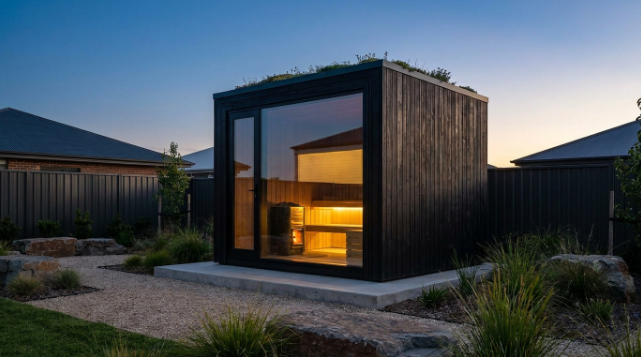
A first-time cube sauna buyer should check five things before ordering: named wood species and drying process, interior dimensions matched to how many people will actually use it, whether a heater is included or sold separately, the electrical work the heater requires, and warranty length on both the structure and the heater. Skipping any one of these is the most common reason beginners end up with a unit that does not fit their space, their panel capacity, or their budget once installation is added in. This guide walks through each check in order.
Step One: Confirm the Wood Species and How It Was Dried
Not all sauna wood performs the same once it starts cycling through repeated heat and moisture. Thermo-treated spruce and cedar are the two materials that show up most often in quality cube sauna kits, because the thermal treatment process reduces the wood’s tendency to absorb moisture and warp over years of use. Knotless thermo-aspen is a common choice for benches and backrests specifically, since it stays cooler to the touch than denser woods even at high cabin temperatures. A product listing that describes the wood only as “premium” or “select” without naming the species and treatment process is worth treating as a red flag; a legitimate manufacturer states this plainly because it is one of the biggest cost and durability factors in the build.
Step Two: Match Interior Dimensions to How You’ll Actually Use It
Cube saunas are sold by stated capacity, but capacity numbers assume everyone is comfortable sitting shoulder to shoulder. Before buying, measure the space where the unit will sit and compare it against both the exterior footprint and the interior dimensions, not just the capacity rating. A six-person cube sauna, like the SaunaLife CL7G, has interior dimensions of roughly 87.5 inches wide by 70.8 inches deep by 85.5 inches tall, with exterior dimensions closer to 91 by 86.6 by 93 inches once wall thickness is accounted for. That gap between interior and exterior size catches a lot of first-time buyers who measure only the spot for the interior and end up with a unit that does not clear a fence line or roof overhang.
Step Three: Check Whether a Heater Is Included
Most cube sauna listings sell the wood structure on its own, with the heater priced and shipped separately. A larger six-person cabin typically needs an 8-kilowatt or larger electric heater, sized to the cubic footage of the interior rather than the floor area. Buying a heater that is undersized for the cabin means longer heat-up times and a unit that runs constantly without holding target temperature, which shortens the heater’s working life. Checking the manufacturer’s stated minimum kilowatt requirement before ordering, and buying a heater that meets or slightly exceeds it, avoids this problem entirely.
Step Four: Budget the Electrical Work Separately
This is the step beginners skip most often, and it is usually the most expensive one. Electric sauna heaters rated at 8 kilowatts or above generally require a dedicated 240-volt circuit, which most homes do not already have available at the panel near where the sauna will sit. Getting a quote from a licensed electrician before ordering, rather than after the sauna arrives, avoids a gap between when the unit shows up and when it can actually be used. Depending on distance from the panel and whether the panel itself has spare capacity, this line item commonly runs anywhere from a few hundred dollars to well over a thousand.
Step Five: Compare Warranty Terms Line by Line
A limited lifetime warranty on the wood structure, paired with a separate multi-year warranty on the heater, is a reasonable standard for a mid-range to premium cube sauna in 2026. Shorter or vaguely worded warranty terms are common on lower-cost imported units, and they are worth factoring into the total cost comparison, since a heater failure outside a short warranty window means paying full replacement cost. Reviewing the SweatDecks catalog alongside other specialty retailers is a reasonable way to compare stated dimensions, wood species, and warranty terms side by side before committing to one model, rather than relying on marketing copy alone.
Step Six: Plan the Physical Site Before the Sauna Ships
A cube sauna needs a level, well-drained surface, whether that is a reinforced deck, a concrete pad, or compacted gravel with pavers. Shipping weight is a useful proxy here: a six-person cube sauna in the 2,000-pound range needs a surface that can bear that load without settling unevenly over time, which an unreinforced wood deck may not be able to do without additional joists. Confirming pad or deck capacity before the sauna arrives, rather than after freight delivery, prevents the awkward situation of a crated sauna sitting in a driveway while the site gets sorted out.
Step Seven: Check Delivery Terms Before You Order
A large cube sauna ships via freight, not standard parcel carrier, and freight delivery for a unit in the 2,000-pound range is typically curbside only, meaning the crate gets dropped at the end of the driveway rather than carried to the backyard. Beginners sometimes assume white-glove delivery is standard and are caught off guard when a freight truck simply drops a pallet and leaves. Confirm whether delivery is curbside or includes placement, and line up help or equipment to move the crated panels to the install site, before the truck shows up. Many retailers offer free freight shipping above a set order threshold, commonly $500, which is worth checking against the total order value including any heater and accessories.
What the Research Actually Supports
Buyers researching sauna use often run into strong marketing claims about health benefits, and it is worth knowing what the underlying research actually says before treating any of it as a purchase justification. A 2018 review in Mayo Clinic Proceedings summarized associations between regular sauna bathing and lower cardiovascular event rates in Finnish cohort studies, and a separate 2001 review in the American Journal of Medicine covered both benefits and known risks, including contraindications for certain heart conditions. A 2023 follow-up review examined whether combining sauna use with other lifestyle factors added further benefit. These are population-level associations, not guarantees for any individual, and none of them should be read as a reason to skip the basic safety and electrical planning steps above.
Frequently Asked Questions
What is the first thing a beginner should check before buying a cube sauna? Confirm the wood species and drying method are named clearly. Vague “premium wood” language is a red flag.
Does a cube sauna come with a heater included? Usually not. Most are sold as the structure alone, with the heater sized and purchased separately.
How many people can realistically fit in a six-person cube sauna? Six adults comfortably, though four or five leaves more room to stretch out.
What electrical work should a beginner budget for? A dedicated 240-volt circuit for most heaters rated 8 kilowatts or higher, quoted by a licensed electrician before ordering.
References
- Cardiovascular and Other Health Benefits of Sauna Bathing: A Review of the Evidence, Mayo Clinic Proceedings, 2018
- Benefits and risks of sauna bathing, The American Journal of Medicine, 2001
- Does the Combination of Finnish Sauna Bathing and Other Lifestyle Factors Confer Additional Health Benefits? A Review of the Evidence, Mayo Clinic Proceedings, 2023
By Nathan Reyes